
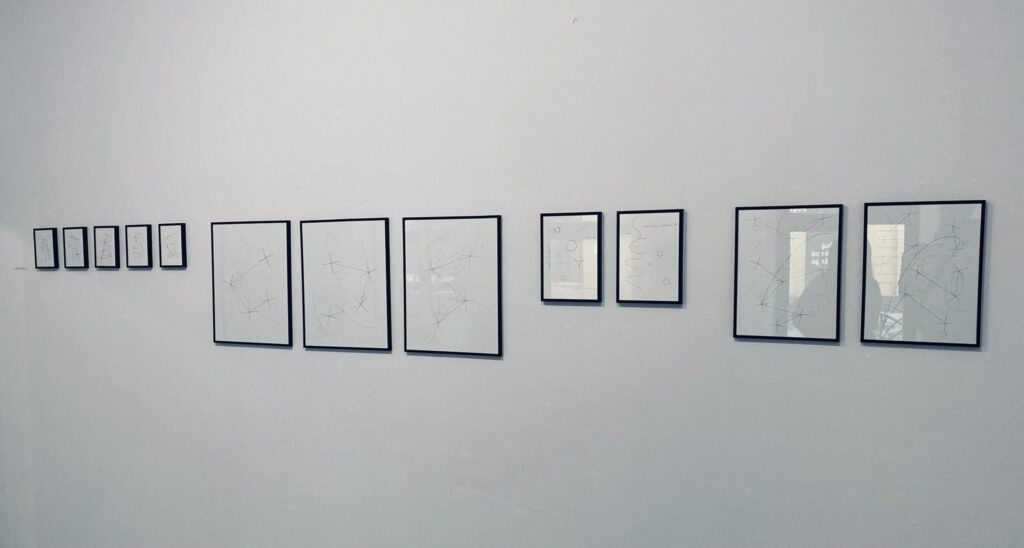
Every step we take in life is both a commentary on the past and a move into the future. It is the present in which we define ourselves. It is hard to know what the right decisions are, everybody finds that out very early in life. We may try to follow the traditional path in the hope of doing the right thing, however, it goes without saying, traditions are not fixed but are constantly changing. Tradition, seen at the level of customs or social behavior, is not as stable as we may want it to be. We face continuous breakdown of tradition. Our current society seems to be specialized at that. How to deal with that volatility?
In the present moment we decide the next step. How do we do that? Where does the information come from? Are we using the right information? After years of working with almost nothing more but a pencil and a piece of paper, I have come to the conclusion that the moment when the point of the pencil touches the paper is of pivotal importance. The question in drawing is: what movement will happen and why? I see repetition and impulses. Lines flying everywhere, trying to connect and join up to form images of this or that sort. What are they trying to convey, what does it mean? I have come to think about these questions as like stepping into the unknown. And then what?
When you step into the unknown, the first thing you need is a brave heart and the second thing is prudence. And when courage and prudence go hand in hand, when they are friends, that is next level. So, you step into the unknown, let’s say it is dark too, the next thing you do is stop and listen. If no harm comes to you, you take the next step. And then you listen again. What do you hear, smell? How does it feel? This is connecting to the subtle energy.
The interplay between courage and prudent listening into the subtle energy constitutes our decision-making. You are on your own, nobody tells you what to do, or what not to do. That is the situation of the artist who understands his position. The unknown we are thinking about here can also be interpreted as the imagination. In our inner vision all kinds of things are living and experiencing in ways that are inexplicable, even uncontrollable. We are hardly the autonomous creatures we think we are, or wish ourselves to be.
How to navigate? When we think about traditions, patterns of behavior, or linear patterns in drawings, the basic structure is always the same: behavior has a tendency to solidify and repeat itself and then breaks up again under the circumstances, under the influence of the information we receive from the unknown. There is no everlasting tradition nor a perennial break up into the new. Therefore, the decisions we take, are dependent on our capability of handling the unknown. This is what we are up to as an artist and as a human being.
Gerard van der Horst
This text was presented at the 2025 DGAA exhibition “Tradition / Everyday life / Press review”, at DG Gallery, Łódź, Poland