
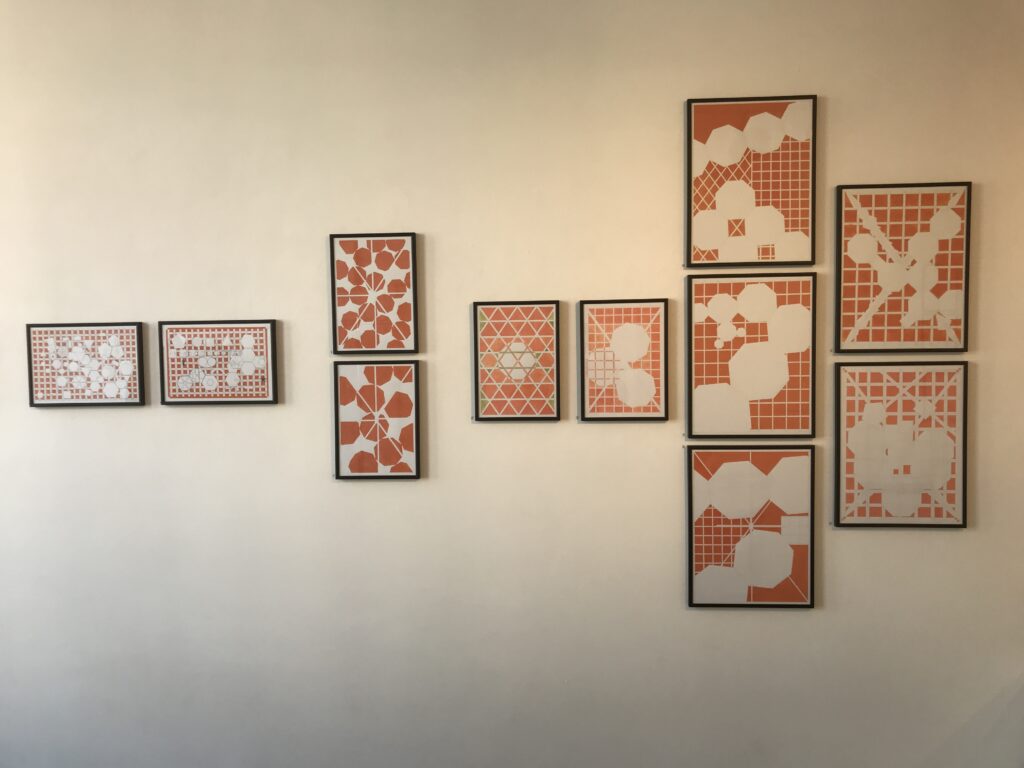
Drawing a grid is a concrete activity. Sometimes it even looks more like a preparatory activity than an artistic act. The grid has different properties, such as the line thickness, the relative distances of the lines, the colors and materials used, and so on. These differences in properties naturally lead to differences in aesthetic experience. Concrete art turns such operations into complete oeuvres. The core experience of concrete art is that you see what you see, it is what it is. Concrete art lives by itself and has a rationalistic tendency, because ideally the operations are rationally conceived and accurately executed.
The mind wants simplicity, clarity and consistent execution. This can lead not only to cerebral conceptualism but also to an unbridled explosion of decorative tendencies and mannerism. Moreover, the motive of meaning seems to be missing. Should art be decoration or a social event or a political statement? Doesn’t meaning deserve a central place in artistic work? To what does concrete art relate? And to myself as an artist working in this field: how can my work deal with these questions? And what is meaning anyway? To begin with, answers are not predetermined or derivable from abstract principles. It is more likely that we need to explore these issues by working on them to gain more experience and understanding.
Working in search of meaning implies skipping the idea that you first need to know your visual concept to then execute your idea. Instead, I think it is better to develop a pattern of behavior similar to a journey into the unknown: starting more or less impulsively with a line and then continuing to draw a next line that is also a reflection on the first one. This leads to patterns of lines that are interconnected and open to the infinity of possibilities. It is like a dialogue between impuls and reflection. Reflection is a position of overview and accepting what is. Impulses and reflection have more to do with feeling than conceptual ideas. This is working with the feeling of openness. To anchor this process I use an empty space in the center of the drawing. This empty or open space is the unknown or a representation of the mystery of life.
The open space in the center brings about line and shape configurations in the surrounding spaces. It is the basis of more or less symmetrical processes in all directions. This first appeared in the ‘Manifestor’ drawings. The Manifestor is the energy that brings the imaginary to reality. In the ‘grid spirit’ series I concentrated on combining these configurations with a grid. It also reminded me of the much older ‘chess drawings’,the first series of which I made in 1987. A grid can easily be thought of as a kind of chessboard that demands action. The shapes that emerged in the grid spirit drawings have a life of their own, ever-changing, not unlike the graphic mutability of the chess drawings. The difference is that the information of the Chess Lines came from an external source, while the information of the grid spirit drawings comes from working with the feeling of openness. This is the way to experience meaning.